
“Sexmission” and How It’s the Greatest Sexist Comedy of All Time

We often hear people say that something “didn’t age well,” meaning it has become outdated, offensive, or no longer relevant to contemporary society. Especially with reference to movies, that phrase has become exceedingly popular, often debunking their ability to stand the “test of time”. This is particularly the case when the said films fail to adhere to current standards or values, or simply perpetuate ideas that no longer resonate with new generations of viewers. Consequently, iconic movies that seem to be ingrained in our cultural, linguistic, and social fabric, are often questioned and called out for “not having aged well”. One such film now facing scrutiny is “Sexmission” – an undeniable classic that redefined Polish comedy cinema and still has audiences bursting into laughter, despite its political incorrectness.

“Sexmission” is a Polish sci-fi comedy directed by Juliusz Machulski in 1983, which tells the story of two men – Max and Albert – who undergo hibernation in 1991 for a scientific experiment only to awaken 53 years later in a totalitarian world devoid of men, ruled by matriarchy. As they wake up in what resembles a futuristic hospital ward, Max and Albert receive some news from their female doctor, Lamia. They learn that a nuclear war had ensued, while they were sleeping, in which a nuclear weapon, initially meant to temporarily paralyze male genes, resulted in their complete annihilation, leaving the two protagonists as the last two men on the planet. They learn about parthenogenesis – the method by which women had been able to reproduce by generating solely female offspring in laboratory conditions. “Piercing virgin eggs… In the uterus… Mechanically… Egg on egg…” stammers Albert, as Max cries out, “Not while eating, for heaven’s sake!”. They also find out that the world they now inhabit is entirely artificial and located underground, as the Earth’s atmosphere is believed to remain highly toxic after the war. As they try to navigate this new reality, they gradually realize that they have become lab rats under this new regime, and conformity is not an option. Consequently, they decide to flee the underground – a decision that proves to be far more challenging to execute than they initially anticipated.

The movie, now roughly 40 years old, sparks some controversy in a highly democratic and liberal world, where many find the association of female emancipation with a totalitarian regime derogatory and inappropriate. The iconic remarks made by the characters in the film, though comical in their absurdity, are also undeniably sexist, acting as one of the reasons why the movie receives backlash. What many people fail to notice, however, is the purpose that sexism serves in the movie. To grasp its significance, it’s crucial to understand the socio-political situation in Poland during the 1980s. Between the 1950s and 1980s, Poland, then known as the Polish People’s Republic, was under the communist dictatorship of the Soviet Union. Art and culture became instrumental in shaping socialist attitudes among the populace, leading to heavy censorship and propaganda that significantly influenced what was presented to the public through mass media. As a result, art that managed to pass through censorship was often peppered with symbols and allusions referring to the political situation, which, though illegible to the dictators, strongly resonated with regular citizens living under the regime. Thus, any form of artistic expression became an important tool in mobilizing citizens across the country and countering the propaganda set out by the communist leaders. Similarly, “Sexmission,” which premiered during the communist era in Poland, became a symbol of the totalitarian rule of the USSR, merely disguised as a female dictatorship. By portraying the horrors of a world dominated by one gender, the movie reflects the repercussions of living in an oppressed country dominated by a single, totalitarian ideology.

Initially, Max and Albert conform to the reality they find themselves in – Max flirts with women around him, while Albert appears fascinated by the technological advancements. However, their paranoia grows as they discover food on the breakfast table to be artificial, and tasteless – “Oh sorry, I burped from the plastic” – and the space in which they’re confined to be filled with cameras and wiretaps. “There are no men? But why are there no windows here? And why are there no doorknobs here?” – Max frantically shouts – “The door is electrified! What? A tunnel? A lamp in the floor! Everything is messed up!”. As their escape plans turn out futile due to the wiretaps and constant monitoring by the female staff, the male characters grow even more exasperated – “I can’t take it anymore! Permanent invigilation! I can’t take it anymore!” yells Max animatedly. After yet another of many futile escape attempts, the women give them a final chance to conform by offering the option of “naturalization,” or a sex reassignment surgery that would permanently change their gender. When the gentlemen refuse, they find themselves with no choice as they’re immediately taken to an assembly where women are about to decide their fate in their presence. “We will not allow the return of a world in which the woman is a waitress on the banquet of life where the males feast,” says one of the assembly members, Dr. Tekla. “The male is your enemy!” she exclaims, while Albert responds fiercely, “If not for men, the world wouldn’t have moved forward. The history of progress is that of men. You cannot deny that! All the great scholars, the fathers of progress, were men!”. “Like who?” a dialogue ensues. “Copernicus,” Albert responds. “Lies! Copernicus was a woman!” he hears back and replies, “What? Einstein, then!” “Maybe Curie-Skłodowska too?” can be heard in response. “These phallocrats speak of male inventions. What is it that they invented? A male named Cain invented murder and tested it on his sister Abela. Another one invented prostitution. Another one, slavery. Briefly speaking, we owe all the world’s evil to you. From religious wars to cervical cancer” states Dr. Tekla firmly. “Sure! The only things that aren’t our fault are hailstorms, earthquakes, and whooping cough!” shouts Max sarcastically. Despite their efforts, the trial ends with women opting for the “naturalization” of the last two males, leaving Albert and Max with no choice but to flee. “Why are they running? It all ended well,” asks Dr. Lamia after the end of the trial, puzzled by the men’s constant refusal to conform and become part of the dominant sex.

“Sexmission” is not merely a “sexist comedy”, but rather a depiction of the mechanisms that drive the indoctrination and isolation of individuals in an oppressive system. Max and Albert essentially have no say in their fate and are forced to conform to norms they don’t agree with. Moreover, the image of the matriarchy propagated in the underground does not exactly match the reality faced by the male protagonists, similar to the false image of the Polish People’s Republic cultivated through propaganda during the communist era. The film prompts us to reflect on the consequences of a society driven to extremes – a society of complete uniformity and conformity, upheld through authoritarian ideology and doctrine. “Sexmission” will forever remain one of the most significant movies in Polish cinematic history, standing the test of time and reminding us, Polish viewers, that in the East, “there must be some sort of civilization”.

“Saltburn” and the Unique Aesthetic of the “Female Gaze”

In recent years, the concept of the so-called ‘female gaze’ has grown exceedingly popular, particularly with reference to visual media and pop culture. The term can be defined as the female point-of-view which focuses on portraying authentic experiences, desires, and perspectives that are central to women. It mostly refers to movies created by female filmmakers or screenwriters, who introduce a female perspective to the narrative, but it may as well refer to movies that follow a female-centric storyline, where the protagonist is a woman. As one can see, the notion of the ‘female gaze’ is quite loosely defined, remaining largely open to interpretation. Yet, to understand its essence, it’s crucial to ask ourselves – ‘Where has it emerged from?’ – and – ‘What did it respond to?’.

The idea for the “female gaze” came from Laura Mulvey’s 1975 essay, called, “Visual Pleasure and Narrative Cinema” which discussed and critiqued the concept of the “male gaze” in regards to the old Hollywood cinema. In her essay, Mulvey considers such aspects of the classic narrative structure as – “the way the camera films an event,” “the way the viewer watches what has been filmed,” and “the way the characters look at each other.” The author of the essay states that classic Hollywood cinema places the viewer in a masculine position by default and that the main purpose of female characters is to serve as objects of desire on screen, who are to be looked at both by the audience and the male characters within the narrative. The essay prompted some intriguing ideas that not only gave rise to a new generation of feminists whose involvement forever changed a one-sided and sexist industry but also, bettered the understanding of male and female subjectivity and the impact they have on storytelling.

“Male gaze” revolves around deriving visual pleasure from the acts of “viewing” and “peeping.” It operates on the premise that the audience either assumes the perspective of the male protagonist, watching the world through his lens, or watching it alongside him. This involves unconsciously objectifying women, as the audience is compelled to “possess” the female character by asserting dominance over her with their gaze – by scrutinizing her from a distance, as if reducing her entire role on screen to mere beauty and physicality. A frequently refrenced example is the filmography of Alfred Hitchcock, particularly notable for the recurring theme of “peeping” or voyeurism. This theme is central to movies such as “Rear Window” or “Vertigo,” where the female characters are meant to be gazed at, to serve as a sort of aesthetic that reflects male fantasies – they’re the embodiment of desire; blonde, elegant, and mysterious. The “female gaze,” on the other hand, introduces a strikingly different perspective – that of being the object of the gaze. It shifts away from pure physicality, focusing instead on narratives that are centered around emotions rather than actions and authentic bodies rather than equipment.

A great examplary movie showcasing these features is the 2023 production called “Saltburn,” which happened to stir some controversies, mainly due to its ‘boldness of representation’. The film, directed by Emerald Fennell, follows the narrative of Ollie, a scholarship student at Oxford University, who’s struggling to fit into the upper-class-dominated environment. As he’s trying to navigate this tumultuous world of power, wealth, and glamour, he suddenly befriends Felix, a popular and ‘privileged’ student at Oxford – a friendship with whom rapidly transforms into a relationship of lie, obsession, and greed. Although the story doesn’t conventionally feature a female protagonist, it revolves around the emotional facets of the main character’s being – crafting an image that’s akin to that of being the subject of “the gaze”.

This “subject of the gaze” perspective is driven by the subtle interplay of emotionality and physicality. External beauty is used as a tool to demask the characters, treating them like layers of the onion – where each outer layer can be peeled to reveal the one beneath it. Visual beauty plays a crucial role in crafting the story, as it highlights what can be considered ’emotionally significant’ in the protagonist’s eyes. In “Saltburn” this is largely achieved by the chosen camera lens – the classic 4:3 format that’s especially known for its ‘retro vibe’ and the uniquely narrow frame that evokes the familiar feeling of nostalgia.

The story is set in Oxford highlighting, as it progresses, the vibrant and idealized reality of the upper-class life. Beauty serves as a representative element, always assisting the characters who are the epitome of the upper class – whether it’s the black-and-white of tuxedos, the glitter and gold of grand parties, or the turquoise skies of Oxford in the early mornings. Colors play an important role in shaping the main character’s perspective – they reflect the emotions that resonate from particular scenes, with vibrant colors strengthening the atmosphere, while pale and delicate shades assist in more intimate scenes, or when the protagonist slightly distances himself from the audience, masking his true intentions and feelings. That can be observed especially as the plot progresses and the setting shifts from Oxford University to Felix’s family mansion – Saltburn. Felix’s character portrayal is also largely shaped by beauty, yet it is not primarily focused on his physicality. Felix is depicted as the subject of desire – he’s being spied on by Ollie, whose obsession with him gradually strengthens, culminating in our protagonist almost crossing a boundary. For example, in the notorious bathtub scene, Ollie is depicted peering through a crack in the door, watching Felix as he lies in his bathtub, in an intimate position (his back arched, eyelids closed, lips parted). The close-ups do not reveal his naked body or highlight the masculine or, as dictated by the standard, attractive masculine features – instead, the camera zooms in on the nape of his neck or his sweaty temple, focusing on the conventionally non-sexual body parts. The use of delicate beige and white colors that persist in this scene accentuates its purity, stripping it of any vulgar or suggestive meaning. Beauty is not used to objectify Felix, and even though he’s literally the object of the gaze, he’s not being shown in a state of uttermost vulnerability as we don’t get to see the whole of him. Even as Ollie’s obsession intensifies and evolves into raw desire, Felix remains partially hidden from his gaze.

The same goes for the main character and the very last scene that portrays him dancing, naked, in the empty Saltburn mansion, right after asserting his dominance over the “envied” upper class and establishing the new “order”. Although his body is by no means covered in this scene, it doesn’t exactly fit into the common definition of sexual imagery – there are no specific close-ups and he’s moving in a slightly disfigured, almost comical manner. The bare body does not serve as the trope of sexuality or desire – it merely responds to the themes explored by the plot. Ollie is now alone, in the empty mansion all to himself, with nobody else to scrutinize or watch him – he has finally escaped the gaze.

In contemporary cinema, the concept of the female gaze does not only serve as a “response” to the decades when the male perspective dominated film and media – it has become a way of crafting a narrative that truly reveals what it’s like to be the object of scrutiny. It aims to portray beauty in a non-conventional way – one that is not meant to disarm the beautiful characters and assert dominance over them by limiting their role to being mere objects of visual pleasure. Instead of just admiring the external layers, the audience is invited to peel the onion – to unveil a more profound beauty that lies hidden beneath the surface.

“Giant” and the Anatomy of the Conservative South

Over the past century, the political landscape of the United States has undergone some drastic changes, giving rise to the deeply polarized country we see today. Despite the liberal movement that ensued in recent years across the states, certain regions remained largely unaffected by these socio-political changes. Southern America, the region once regarded as the “Solid South”, continues to hold the image of the “stronghold” of conservative and traditionalist ideals, with the largest community of right-winged Americans. This distinct division between the liberal North and conservative South, as one can imagine, is not a recent phenomenon – but something that inevitably emerged in response to the isolation of northernmost and southernmost parts of the country, and the unique geopolitical situation they found themselves in.

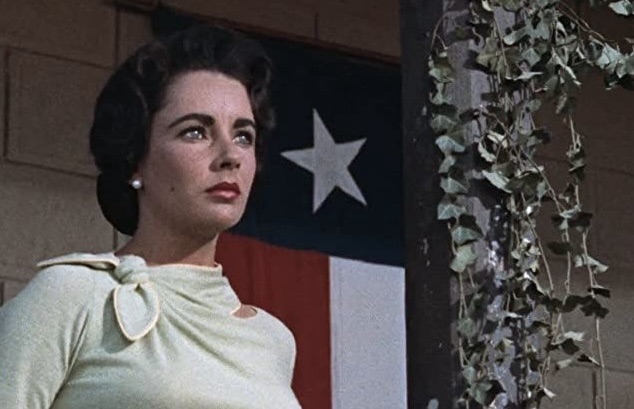
One particularly interesting state has been often reffered to when exploring the theme of “Conservative America”. Texas. The second biggest state – the size of France – home to the American cowboys, rodeo, and barbecue, and a neighbour to Mexico. The politics of this state being pretty much ingrained in its culture and history. It’s been frequently portrayed in literature and film, one of them being the 1956 film “Giant,” featuring Rock Hudson, Elizabeth Taylor, and James Dean. The movie is set in the mid-1920s, telling the story of a wealthy Texas rancher Jordan “Bick” Benedict Jr., who travels to Maryland to purchase a horse. Upon his arrival he meets Leslie, a charming socialite who immediately captures his attention. Visibly intrigued by the wealthy rancher, Leslie strives to make an impression and delves into compulsive reading about Texas. Bick instantly strikes the audience as a “proud Texan” – he describes his home state as his “country,” refers with sentiment to his ranch, Reata, and proudly mentions the vast quantity of acres he owns. Leslie, on the other hand, comes across as free-spirited and bold – she poses straightforward questions, and is not afraid to speak her mind. More notably, she appears to be quite sensitive towards social welfare, expressing empathy and sympathy for those unfairly treated. She questions Bick about his perspective on whether he sees it as “sad” that all this land, referring to Texas, was taken away from Mexicans – alluding to the historical period when Texas declared independence from Mexico, establishing itself as a sovereign nation, which existed independently for nearly a decade before joining the United States. Bick’s reaction to the question is filled with astonishment and disdain, as he refers to her words as nothing but “hurtful” and “absurd”. In the very beginning, the movie accentuates a stark contrast between the perspectives of a Northerner and a Southerner, exposing that ethos of independence and state pride that seems to be deeply embedded in the Texan psyche. Despite the differences in character and worldview, the chemistry between Leslie and Bick swiftly brings them closer together, initiating a relationship that rapidly evolves into marriage. As a happily married couple, they head to Reata, Bick’s ranch – which, for Leslie, means adapting to an entirely new reality. From the moment Leslie sets foot in Texas, she noticeably distinguishes herself from the locals by showing kindness towards the Mexican working class, introducing herself to the maids, drivers, etc. This draws the attention and scrutiny of other Texans, who appear to be vividly concerned about her lack of restraints and understanding of her social status. Bick argues with his wife, stating that someone of her “kind” shouldn’t engage with “such people”. Despite her husband’s objections, Leslie continues to visit impoverished Mexican settlements near the ranch, unable to turn a blind eye to the despair of others. The Texas she was met with is not what she anticipated – it’s a world marked by inequality, social divisions, and male dominance, as she’s about to find out.

When she attempts to join a political conversation between Bick and his colleagues, she’s promptly excused from the room – “You’d be bored, honey. This is dull. We’re talking about politics.” Unaware of the pretext, Leslie persists, stating, “Why, I’d be fascinated! Please go on talking. I’d love it.” “This is men’s stuff, men’s stuff!” – Bick firmly responds, before one of his colleagues adds sweetly – “Don’t you go worrying your pretty little head about politics.” “You mean my pretty, empty head, don’t you? You gentlemen date back 100,000 years! You ought to be wearing leopard skins and carrying clubs… What’s so masculine about a conversation that a woman can’t enter into it?” – she retorts. Suddenly, her socialite upbringing and education don’t mean much in the face of the traditionalist gender norms in the 1920s South.

The argument between the couple concludes with Leslie apologizing, and Bick asserting his dominance in marriage by clarifying – “Everything that has a Reata brand is run by me. That’s the way my father ran this outfit and my grandfather, too. He kept it together for his son, and my father for his. And I’m keeping it together for mine.” This obsession with land as a family legacy is a recurrent theme in the movie, which is showcased by Bick’s character whose whole purpose seems to come down to upholding traditional norms and ensuring that the family name endures lives on. His traditionalist value system is gradually challenged as the story progresses and he grows older, witnessing his kids maturing and the world around him – changing. One of the subplots that contribute to these changes involves Jett Rink, once a laborer on Bick’s Reata. Upon a deceased family member’s wishes, Jett inherits a portion of the land — the family legacy — and stumbles upon oil on his plot. Gradually we watch the land around Reata being filled with drillers and tanks of the “Jett Rink Company”, which deeply disturbs Bick, as the mere prospect of his ranch being exploited for oil poses a threat of losing the family legacy – the brand behind the Benedict name. Initially, Bick firmly rejects the very notion of selling his land for oil drilling, however, as persistent pressure mounts from the inevitable realization that none of his kids harbor any interest in inheriting the family ranch, Bick eventually gives up and decides to sell Reata. Later on, we see him – once a rancher, a Texan cowboy – now lounging beside his own pool – a wealthy businessman – solemnly reaching the conclusion that “oil or no oil – it doesn’t matter anymore”. Bick’s fate reflects that of numerous Texans who underwent a profound change, shifting from ranchers to entrepreneurs amid the economic boom of the 1900s in Texas. The land, once a tangible aspect of the Texan identity, lost its significance as the American dollar emerged to take its place.

Ironically, instead of cultivating the family traditions and adhering to their father’s conservative views, Bick’s children end up ignoring his expectations and forging their own path for themselves – his daughter, Luz, fleeing to Hollywood to become an actress, and his only son, Jordan, marrying a Mexican girl in secret. The Benedict name gradually losing its “prestige” along with the remnants of its once-high status. An argument breaks out after Jordan’s wife is refused service at a beauty parlor, which just so happens to be owned by Jett Rink. After his son’s failed attempt at confronting Jett, Bick decides to take matters into his own hands, dragging Jett “outside” for a fight. Nevertheless, this doesn’t stop an argument from ensuing between Bick and his son. “Who went after Rink? Your old man.” – states Bick demanding respect. “And why?” – asks Jordan angrily – “Because of my wife? Because your son, Jordan Benedict… a descendant of the long, proud line of Reata… got knocked flat on his back in front of all Texas. That’s why!”.

The narrative reaches a climax the following day as Bick and Leslie, trying to reconcile and repair the rift caused by previous events, decide to take Jordan’s wife and their grandchild to a diner, where the staff seems to be looking disapprovingly at the Mexican customers. Bick oblivious to the whole situation doesn’t see the innuendo behind the staff’s scranched-up faces. When he notices a Mexican family at the next table being aggressively thrown out of the restaurant by the waiter, Bick suddenly erupts and attacks the aggressor. Joyful Texan music starts playing in the background, as the two men fight and true chaos ensues – tables are flying, glass is breaking, blood mingling with ketchup. The comic scene reaches an end as the waiter hurls Bick onto a table, causing a salad to collapse on his face. Bick lies there, defeated, while the waiter seizes a sign from the wall – the inscription reading “We reserve the right to refuse service to anyone” – and flings it onto Bick’s ketchup-smeared chest. In the movie’s final scene, we observe Bick sitting miserably in his wife’s arms, declaring, “I’m a failure. Nothing has turned out like I had planned.” To which, after a brief silence, she responds with words – “Do you want to know something? You know all that fine riding you used to do, and all that fancy roping… and all that glamour stuff you did to dazzle me? It was impressive. But none of it ever made you quite as big a man to me, as you were on the floor of Sarge’s hamburger joint… When you landed crashing into that pile of dirty dishes… You wound up on the floor, on your back, in the middle of the salad, and I said to myself: ‘after 100 year the Benedict family is a real big success.'”.

The story of the Benedict family portrayed in “Giant” is in reality the story of Texas itself. Bick undergoes significant character development and a worldview crisis, eventually forced to reevaluate his values and beliefs. He comes to the realization that the bygone era of Western cowboy culture is no more. The times have changed, and so has the land. While his conservative views may have been challenged by the rise of individualism and liberalism, they weren’t entirely replaced or overthrown. In the diner scene, Bick transcends his prejudices in the name of a greater ideal. He ultimately manages to preserve the family name and honor by standing up for the family of someone else’s. Texas had grappled with similar obstacles, brought about by economic, cultural, and societal changes. Its history with immigrants, oil, and capitalism culture following the economic boom, all painted the picture of the conservative South we know today. While the prevailing political ideology of the South remains largely the same, the people themselves have changed, and evolved, consequently transforming the landscape of conservative politics. Its story serves as a reminder that conservatism is not all about land, radicalism, and strict principles. It’s about striving for balance between preserving what’s valuable and embracing the inevitable forces of change.

Design a site like this with WordPress.com
Get started