And Which Road Do You Choose? – “Belfast” on the Fight or Flight Dillema

Generally, we say that a person’s life can follow one of two paths. One can either turn left or turn right and then continue their journey from there, but one cannot really go back to the fork in the road and take the turn again – if one did so they‘d be driving against the traffic, and perhaps they‘d lose their driving license in the process. In other words, we tend to classify our life choices as either “bad” or “good,” based on some ideals established from above – these can refer to norms imposed by religious beliefs, societal standards, or personal desires, all of which guide us through life and its complexities. Thus, we often hear people saying that “someone went down the wrong path” or that “he made the wrong decision in life,” as if he failed to live as expected; failed to do what’s “right” when the time to decide came by.

This metaphor of life as a road can take on different meanings and can be applied to various scenarios – especially to situations where there seems to be no way out; where, at the fork of the road, both options seem equally “unfavorable”. This duality of choice and the question of “which road to take” is also a central theme in Kenneth Branagh’s movie Belfast. The film is set in late 1960s Belfast, Northern Ireland, during a period known as “The Troubles,” when a series of violent riots, bombings, and street fights engulfed the city. The conflict arose from mounting tensions between Catholic nationalists, who sought unification with the Republic of Ireland, and Protestant loyalists, who favored continued union with the United Kingdom. Although the main root of the conflict lay in politics, it quickly extended to theological differences, deepening the divide between Catholics and Protestants. In Belfast the narrative focuses more closely on one of the conflicted sides, portraying the life of a Protestant family against the backdrop of “The Troubles”. At the time, Protestants represented rather a minority among native Irishmen but a majority among British settlers in Ireland, thus they were often seen as a negative British influence – a threat to the idea of a united Ireland, or a form of colonialism on the country’s political and cultural autonomy. However, the community initially portrayed in the film doesn’t seem to match that picture – we get to see them living a quiet, suburban life, with parents working regular 9-to-5 jobs and kids running around the block, playing hopscotch in the neighborhood. At first glance, they seem identical to their Catholic counterparts – they speak the same language with the same accent, live in similar houses, and believe in the same God. There’s nothing particularly threatening or distinguishing about them.

The main character, 9-year-old Buddy, belongs to a Protestant family living in a peaceful working-class neighborhood with both Protestant and Catholic neighbors. We see him playing with his friends on the streets, running around the working-class alleys that gradually become the epicenter of fights and riots, prompting Buddy to reflect upon the division brought about by “The Troubles” and the scary reality he’s struggling to understand. He witnesses daily the turmoil in his once peaceful neighborhood and sees people being forced to take sides, further driving the divide. The opening scene depicts a group of Protestants attacking Catholic homes on Buddy’s street, while his family strives to remain neutral, somehow caught in the middle of it all. The lives of Buddy and his family members – “Pa,” “Ma,” “Granny,” and “Pop” – reveal the struggles of maintaining neutrality as they face the pressure of having to decide – of being forced to take up either an offensive or defensive stance. This can be vividly seen through Pa’s example when a local criminal group of loyalist Protestants repeatedly nags him to get involved in taking offense towards Catholics, despite his constant refusals and indifference towards aggression. Similarly, our main character seems to be in a metaphorical “pickle” as he’s trying to understand what makes the two conflicted communities – Protestants and Catholics – so different. At some point, he even begins to question his neutrality, striving to pick a side – to choose between the “good” and “bad” road. We watch him trying to navigate this struggle, striving to understand the two conflicting perspectives. “I’ve nothing against Catholics…but it’s just a religion of fear,” says Pa, when Buddy asks him about his stance in the conflict – “It’s all bloody religion, that’s the problem.” Nevertheless, Buddy’s family attends church, where our main character becomes more exposed to the Catholic perspective. A critical scene takes place when Buddy witnesses a harsh speech being delivered by the minister at the church, alluding to the recurring “fork in the road” theme. “And where will YOU go? – the minister exclaims venomously – “Picture the scene: a fork in the road. In one direction, a straight and narrow highway; in the other, a long and winding road. One will take you to the bosom of the Lord’s grace forever; the other will spew you into an eternal pit of sulfurous, suffering, pustulating pain. And I ask you here and now, which road will you take?”.

Even Ma, Buddy’s mother, struggles with the “fork in the road” dilemma. When Pa suggests they leave Belfast, she continually defers the decision, offering various excuses to stay. She defends her skepticism about leaving by convincing Pa that staying is best for their children: “Here everybody knows them, everybody likes them, and everybody looks after them. If we go over the water, them people are not gonna understand a word we say, and half of them’ll take the hand outta us for sounding different.” Eventually, at “the fork of the road,” Ma and Pa decide to flee and leave everything behind to start a new life elsewhere. However, when they announce their decision to the kids, Buddy vividly demonstrates his disapproval, yelling and crying, not wanting to forget, as he puts it, “what road he has to go down when he’s dead.”

The “fork in the road” dilemma portrayed in “Belfast” is a universal theme that resonates deeply especially today. In the face of current military conflicts in the Middle East and Eastern Europe, migration has become an increasingly important issue. Millions of people are forced to decide whether to escape their crumbling reality and flee or stay and fight for the life they once knew. In either case, one loses something and gains something at the same time. Leaving means starting anew and losing the sense of belonging to a community that no longer feels familiar, but it also means gaining new opportunities and escaping what held one back in the past. Similarly, staying means facing the obstacles of changing reality and the haunting demons of the past, but it also means maintaining one’s sense of belonging and the comfort of familiarity. As much as we would like to remain neutral in situations like this – to lose none and gain all – it is virtually impossible to stay at the fork of the road forever. One must simply decide before it’s too late – before the decision between the “good road” and the “bad road” is made for them. Buddy’s family eventually leaves Belfast, and the audience can only wonder how taking that road turned out for them. The same goes for the people nowadays having to abandon war-torn areas – we can only wonder what they lost and what they gained at the end. But the thing is, that for all these people, arriving at the fork in the road, the good and the bad routes will always appear different, just like the same decision was perceived differently in the eyes of Buddy, Ma, and Pa. So to all of us, impartial observers, who think we know what they would do in these people’s shoes, think again and really ask yourself: which road do you choose?


“American Fiction” & the Hazards of Political Correctness in the Literary World

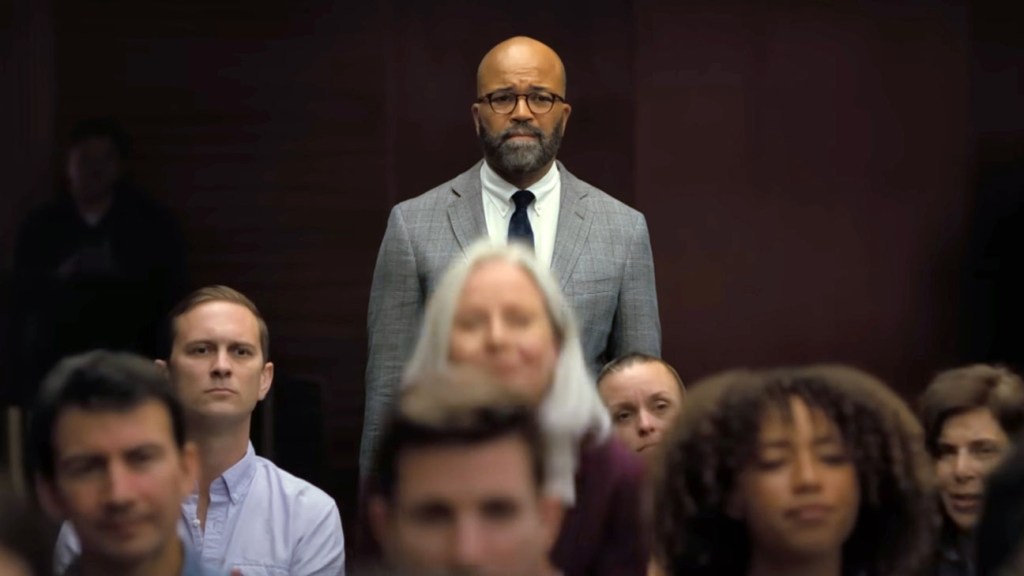
AMERICAN FICTION, Jeffrey Wright, 2023. © MGM / Courtesy Everett Collection

Equality, tolerance, and freedom of speech. These are among the few values that come to mind when one considers a democratic society. It embraces inclusivity, strives for all voices to be heard and equal opportunities to be given, specifically those who’ve been historically disadvantaged. There’s no room for ostracism, no room for inequality, no room for opression. This prompts us to wonder – is absolute equality even achievable? And if so, to what extent can something be absolute before crossing into the realm of oppression? This paradox becomes particularly evident in the literary world, where intellectual freedom essentially drives artistic expression, allowing authors to craft unique stories that resonate with us, readers. However, this freedom appears to be increasingly restricted with the rise of book censorships masked under the pretext of “political correctness”. In theory, it’s aimed to ensure fair representation of the minority and foster a sense of inclusivity for “everyone.” However, in practice, it pressures authors into solely crafting characters they can personally relate to, thereby limiting the scope of perspectives depicted in their works.

Afterall, can fiction and political correctness coexist? Or can they be mutually exclusive in certain respects? This issue serves as a central theme in American Fiction, an Oscar-nominated film directed by Cord Jefferson. The story revolves around Theleonius Ellison, also known as “Monk” – an African-American writer and college professor who’s forced to take a temporary leave due to his confrontations with students. Despite receiving academic validation for his novels, they sell poorly – they’re just not “Black enough,” as his publishers put it. He keeps being compared to another Black writer – Sinatra Golden – who, unlike him, happens to be very successful with her bestselling novel We’s Lives in Da Ghetto. At first, our protagonist remains oblivious to this fact, unable to comprehend why people would want to read such a stereotypical piece of fiction, built entirely on racial clichés. However, as the story progresses, he becomes increasingly wary of the forces driving the demand for this sort of literature, revealing the hypocrisy within the seemingly “politically correct” publishing industry.

Monk himself comes from an upper-class family living in Boston. We meet his sister, Lisa, who’s a physician, and his brother Clifford, who’s a plastic surgeon. We also catch a glimpse of his mother, an elegant elderly lady who lives independently with her own maid – which is also a sign of the family’s undeniable wealth. The Ellisons seem to defy almost every aspect of “Black representation” that’s so readily propagated by the publishing industry. They’re mere intellectuals who don’t pepper their daily conversations with Black slang, lack a criminal record, and most crucially, do not come from “da ghetto.” Also, the problems they face aren’t race-specific but rather universal – intrinsic to us, humans. Lisa’s concerned with her mother, recognizing early signs of Alzheimer’s disease. Clifford is a divorcee who’s on a tough journey of sexual rediscovery, who also indulges in drugs and casual sex as a means to avoid confronting his real feelings. Lastly, Monk grapples with the lack of appreciation for his craft and the toxicity of his industry, all while witnessing his family slowly falling apart. Pressured by the publishers and his personal drama, he eventually writes his own piece of “Black fiction,” mocking the ideal expected from African-American writers. Ironically, My Pafology published under the pseudonim of “Stagg R. Leigh,” turns out to be Monk’s most successful book. Driven nearly to insanity by the absurdity of his situation, the protagonist pushes the boundaries even further, changing the title of the book into a slur to sabotage his lucrative deal with the publishers. Once again, to his surprise, the change is accepted and the book gets published under the new title. His work quickly becomes a bestseller, and in response, clinches a literary award from the New England Book Association. Yet much to his astonishment, while the majority of other authors laud it as “brilliant,” Sinatra Golden deems the book as “pandering”.

When Golden and Ellis finally interact, he questions her about the book, striving to understand what what sets her work apart from that “pandering” piece of fiction. In response – visibly offended – she claims that she thoroughly researched the topic beforehand and that it’s based on the harsh realities of real people’s lives. She states that she doesn’t need to write about her personal experiences, but rather about “what interests people”. “I’m OK with giving the market what it wants,” she says. “But you’re not fed up with it? Black people in poverty, black people rapping, black people as slaves, black people murdered by the police?” he continues, “people – white people – read your book and confine us to it”. They think that we’re all like that.” His rebellion and fury against the hypocrisy of the publishing world eventually fade away, replaced by the feeling of helplessness and the bitter acceptance of reality. He does precisely what he criticized Golden for – he gives the market what it wants and accepts a movie deal on his “pandering” piece of fiction.

As we watch the movie, we observe the protagonist gradually adapting to what he initially considered a broken system – falling into conformity. Apart from his personal drama, one of the deciding factors seems to be his conversation with Sinatra Golden, another African-American author with a similar background yet completely different outlook on fiction. She believes that she’s crafting stories that remain authentic, despite the fact that they cater to her recipients’ taste. She ignores the whole picture and focuses on the truths that people want to hear. Monk, on the other hand, refuses to confine the portrayal of Black diaspora to bare clichés that merely satisfy people. Eventually, even that changes as he realizes that mere clichés will always be more favorable over “real” fiction. The industry will continue to exploit the collective guilt borne by the White majority, distorting the genuine voices and stories of Black individuals. People don’t want to read stories about themselves that remind them of their own fragility and expose their flaws. They seek narratives that make them feel better about themselves – ones that make them feel included.

American fiction is not only a great movie about universal characters and their struggles, but also a sobering reflection of the realities of today’s world. In the era of heightened literary censorship and increasingly pervasive political correctness, fiction is evolving into a perilous territory. While literature and politics have always been somewhat intertwined, their relationship is becoming more and more intrusive, with little mutual benefit. Before stories are officially published and reach the bookshelves of your typical reader, they must be often reviewed by a sensitivity reader first, who assesses the content and ensures it doesn’t contain offensive material, stereotypes, bias, and so on. It’s a controversial topic that could be discussed in a separate essay, but it raises an important issue that brings us to the original question – are fiction and political correctness mutually exclusive? If fiction is by definition concerned with fictitious stories entirely crafted by the authors, is it justifiable to censor the voices of their imaginative characters on the basis of them not being “representative” enough of their minority? Is political correctness enhancing the authenticity of the crafted stories or hindering the imaginative process that constitutes creative writing? Or perhaps both?

American fiction surely depicts the negative side of it, focusing on the repercussions of this political bias on fiction. It kills universality and promotes predictable stories with predictible plots and shallow characters. The stereotypical “Black fiction” portrayed in the movie focuses on extreme cases of hardship – drug dealings, poverty, racism – but they overlook the universal struggles like those experienced by Monk himself – the loss of his sister Lisa, his mother’s deteriorating health, and the break-up with his gilfriend, Coraline. These aspects of his life make him an authentic character with whom each and every one of us can relate. Monk, as well as his relatives, are not depicted solely through the prism of their race, but rather through their daily hopes, goals and sorrows. As a result, the scope of what they can represent can vary from person to person – they neither perpetuate harmful stereotypes nor do they overlook any particular facets of their ethnicity. They are fictional characters but they could easily represent any one of us, regardless of our race.

„Perfect Days,” an Ode to Everyday Joy

Why does it seem so hard to find joy in the little things? To take delight in the mundane and the ordinary? Is it because of the societal expectations that pressure us to aim for the “extraordinary” in life? Or maybe it’s because we are simply wired this way – hating routine, and seeking excitement in novelty and change by default? In a culture that prioritizes quick dopamine rushes and instant gratification, we have become accustomed to seeking joy in momentary pleasures rather than appreciating the subtle joy that comes from familiarity and routine. As a result, we tend to overlook the beauty of everyday experiences, focusing on distant dreams and desires that seemingly enhance our lives – making them more interesting and meaningful – when in reality, they only raise our expectations, leading to bitter disappointment when the resulting joy proves to be insufficient and short-lived. The sole question remains – is it possible to be both extraordinary and content with the ordinary? Is it possible to live a fulfilling life and have, simultaneously, an appreciation for the little things?

The eastern philosophy of minimalism argues that in order to fully appreciate the joy derived from the “extraordinary,” one must first learn to find joy in the “ordinary”. For decades, philosophies like Zen, Buddhism, and Taoism have emphasized simplicity, harmony, and mindfulness as key virtues in life – values that are supposed to guarantee inner peace and spiritual fulfillment in contrast to “external possessions” that, at the end of the day, remain useless. “Perfect days” is a movie that tells the story of ordinary life and the simple day-to-day joy that makes it so worth while. The Oscar-nominated film, directed by Wim Wenders in 2023, follows the story of Mr. Hirayama, a middle-aged man who lives alone in a small apartment in Tokyo. Day by day, he follows the same routine – he wakes up, swiftly folds his duvet into a neat cube, waters his plants, brushes his teeth, and dons his baggy work suit. He then steps out on the porch, looks up, smiles, and with that one silent gaze upwards, you just know that he’s about to have a perfect day. Throughout the entirety of the film, the protagonist doesn’t speak much. As a result, the audience is left to base their perception of Mr. Hirayama on what other characters say about him. “That’s Hirayama, my senior at work. Great worker, but not a great speaker. I don’t even know his voice!” – says Takashi, his co-worker. “Hirayama, you really like this job, huh?” – he once asks – How can you put so much into a job like this?”. “Not that I’m expecting an answer,” – he adds swiftly when met with silence. Takashi’s question reflects the unique relationship our protagonist has with his job – he brings his own set of cleaning gadgets and ensures a high quality of his service, leaving no dirty spot behind. What’s more, he treats the people who come to use the toilets with utmost respect, always waiting outside of the toilet instead of just waiting outside the used cabin. Although the people around him don’t pay much attention to Mr. Hirayama, he seems to ignore it, focusing on other things like nature or different “odd” people who also seem to be “not worthy” of the societal gaze. He makes regular eye-contact with a local homeless man in the park, greating him with respect. Also, every day at the same time after working hours, he sits on the same bench in the park overlooking the trees and takes out his film camera to take a photo. The objects of his photos appear later in his dreams, playing an important role in crafting the story line, and reflecting the unique mentality of our main character. Each day follows the same pattern – Mr. Hirayama goes to work, then he heads to the park to admire the trees and take photos, only to dream about them late at night and return to these very dreams the next day. He doesn’t dream about the great things he could have become or the impressive places he could have found himself in. Instead, he dreams about the moments of his everyday life that made him feel truly blessed and happy. He doesn’t need to travel far away in his sleep, as everything that brings him joy is right here.

Although Mr. Hirayama seems to be completely unbothered by other people’s opinion about him, feeling completely fulfilled and happy with his solitary way of life, there are moments throughout the film when the protagonist is confronted. One such moment occurs when the protagonist finds a small child crying in the bathroom, having lost his mother. He takes the child to search for the lost guardian, but upon finding the mother, he is met with scolding looks. Mr. Hirayama must keep a straight face while the mom wipes her child’s hands with a handkerchief and quickly drags her offspring away, as if trying to protect it from something “dirty” and “contagious”. Another instance is when the audience gets to witness the main character’s interaction with his sister – “Are you really cleaning toilets?” – she says, with a pitiful, yet uncomfortable look, as if genuinely wondering why someone would be at ease with such a “disgraceful” job. At such moments, it becomes apparent to the viewer that Hirayama is aware of his low social status and ordinary life, which contradicts societal expectations. Society anticipates individuals to lead a successful life filled with unpredictability and constant challenges to oneself. Wealth, success, reputation – these are the things that one should dream about at night.

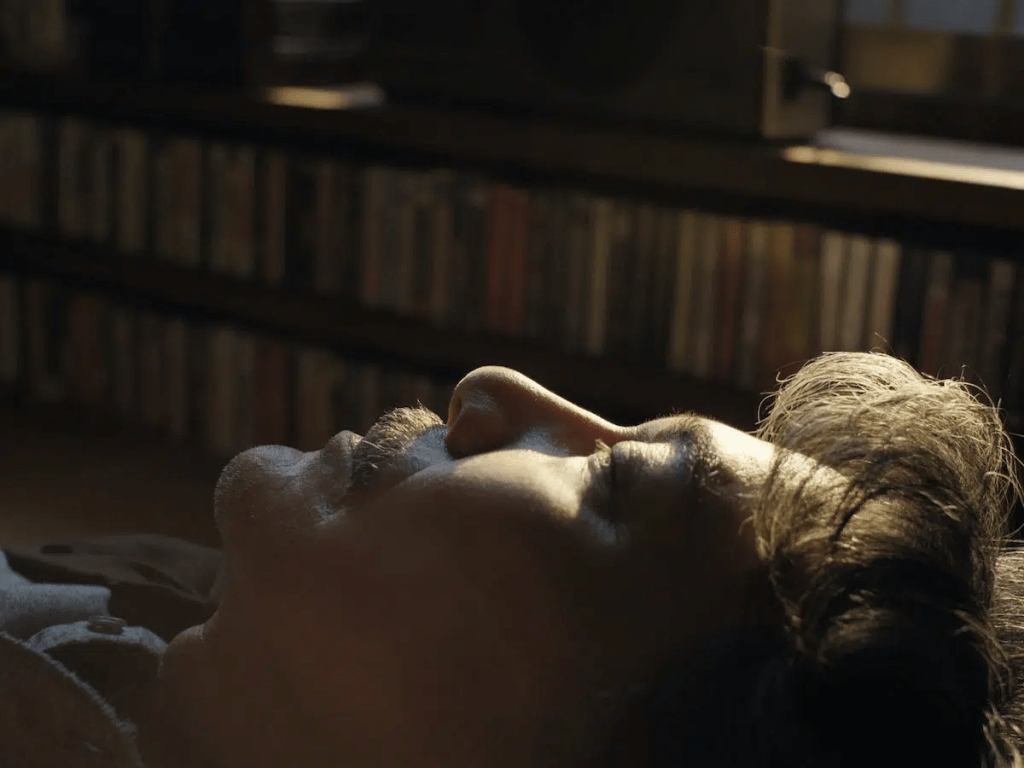
There are certain people, however, on his path who see the real value of Mr. Hirayama’s unique way of living. One such person is the ex-husband of the female bar owner, with whom our protagonist seems to have a platonic relationship. The ex-husband approaches our main character and engages in a seemingly random conversation, only to eventually say, “Please take care of her,” after explaining that he suffers from cancer. To which Hirayama replies, “Oh no, we’re not like that.” “I’m counting on you,” is heard in response. The two men, who are complete strangers meeting for the first time, then proceed to talk about seemingly most ordinary things, as if breaching the decorum mandated by the situation – “Shadows …Do they get darker when they overlap?”. “Not sure.” – Hirayama replies. Consequently, the characters proceed to play around with their shadows, checking whether the hypothesis is true – “Try standing here. What do you see?”. “Looks the same to me,” replies the latter. “Not getting darker?” – the protagonist asks. “Probably not.” “Looks darker to me.” – he responds. “Don’t see any difference.” “But there is! It has to get darker to make sense!” – he exclaims – “Nothing is changing after all? That’s just nonsense.” This conversation gives the audience a glimpse into Mr. Hirayama’s outlook on everyday life. In this analogy, his days are like the shadows – although they initially all seem the same, their “overlap” should reveal some changes over time. According to our protagonist, each day has something new to hold, despite life’s routineness and monotony. Like a photo of the same tree taken taken over and over again, day by day, that somehow manages to look different every time – maybe it’s the light, or the wind blowing in a new direction, or maybe it’s just a state of mind? However, to Mr. Hirayama’s surprise, the metaphorical “shadows” don’t seem to overlap. In the very last scene of the movie, we see the main character driving in his car to work per usual. Yet, this time, we get a close-up on his face – revealing a complex expression that fluctuates between a smile and a look of pain. In the meantime, short bursts of sunlight and shadows play across his face, as if reflecting the emotional depth of the scene. At this moment, we witness negative emotions taking over Mr. Hirayama’s body for the first time. The pain of “perfect days” becomes apparent. In order to take joy in everyday life, the main character strives to live each day in the present, disconnecting from the idea of the past or the future. “Now is now. Next time is next time,” as he puts it. To live in the present, one must give up on the past and future. Perhaps that’s why Hirayama doesn’t try to salvage his relationship with his sister or pursue a new one with the bar owner. That’s the prize he has to pay.

“Perfect Days,” while celebrating the joy of ordinary life, also portrays the hardships that make the seemingly simple living not so simple. The protagonist’s secret to a satisfactory life does not solely lie in the harmony of repetition and the comfort of a familiar routine, but also in coming to terms with the pain of being unable to bridge the gap between the past, present and future. The final scene of the film illustrates, however, that these moments of joy and despair are closely intertwined, and much like light and shadow, they seem to come and go. Perfect days are filled with fleeting moments of “light” and “shadow” – joy and pain – happening one after the other, both coming and going. Hirayama finds joy in the simple moments of his daily life – from waking up each morning, to serving the public, and to appreciating the beauty of the natural world around him. That doesn’t shield him from anxiety and pain. But as the day draws to a close and the “shadows” take over, he finds solace in a smile, reminding himself that “now is now” and “next time is next time.”

Design a site like this with WordPress.com
Get started