There’s something particularly alluring about the vibrant and hectic nature of a big city. Whether it’s the sociocultural diversity or the invigorating dynamic of people always rushing somewhere, restless to get something done – the big city is a truly peculiar place. People from all walks of life come into the city to achieve their dreams, their ambitions and become the better version of themselves – one that surely wouldn’t come to life in a rural or suburban setting. Consequently, the city becomes a melting pot of contrasting beliefs, thoughts and ideals that make up its liberal and exuberant nature.
Especially in Western cultures, a big city has always been synonymous with endless possibility and faith in everyman’s potential. Metropolises like New York, Paris, or Rome have become enclaves for people craving to manifest their individualism and express themselves in every way possible – whether it’s art, writing, or fashion. As a result, the “big city” quickly became an epicenter for socio-political change, bringing people together on an important mission and strengthening the voice of the collective. A great example of that phenomenon is the emergence of a “modern woman” – sexually liberated, independent, career-focused, largely feminist. Yet, despite her not being your “typical” female figure, defying the traditional matrimonial norms, and so on, she still believes in love and struggles with finding it in the big city. This theme of modern womanhood intersecting with love is frequently portrayed on the big screen, and while often glamorized, it raises important questions about what it means to be a liberal and independent woman in modern society and how the quest for love differs in a dynamic urban environment.
Some of these questions are explored in the iconic TV series Sex and the City, which, when launched in 1998, quickly soared in popularity and gained viewers all over the world, eager to follow the lives of four relatable girlfriends trying to navigate their careers, friendship, and love in the bustling New York City. All four characters live a pretty materialistic lifestyle, indulging themselves in shopping, posh brunches, and nights out at lavish bars or clubs. They’re all successful women with well-paying careers, financial independence, and, for the most part, single. Truly the embodiment of the modern woman. Carrie, the main character and the narrator of the story is a journalist who’s writing a column for a magazine where she shares her feminine take on male-female relationships in a big city. She has her eyes set on Mr. Big who exemplifies the so-called Mr. Right, the ultimate full package – he’s successful, rich, elegant, and most importantly, sexy. Next, we’ve got Miranda, a Harvard law graduate who frequently prioritizes her career over her love life. She’s seeking a relationship in which she can lay all the cards and be the one in control, contrary to what the traditional norms emulate. On the other hand, there’s Charlotte, a composed and responsible art dealer who’s simply looking for the great love of her life. She strongly believes in love at first sight and, unlike the other girls, fantasizes about building a big family someday – motherhood and true love being her two greatest fantasies. The last one of the pack is Samantha, the most liberated and sexually expressive of the whole four. She works in public relations and often uses her charms to get what she wants. She’s not interested in love as much as she’s interested in sex and one-time flings, which she utilizes to assert her dominance over powerful and attractive men. Though each one of these characters is different and has a distinct approach towards love, they all seem to have one thing in common – modern womanhood. They all break certain standards and norms regarding traditional femininity, and they all struggle to satisfy their own idea of “love,” though each one of them to a different extent.
While some people say that the iconic show promoted liberal feminism and a refreshing outlook on female sexuality, some also argue that it was quite trivial, perpetuating an unhealthy stereotype of women who glamorize consumerist culture. This seems to be an irresolvable debacle – can women who act like men, demonstrating their power through sex, money, etc; be thought of as feminist? And if they can, then how does love fit into this equation? Though on one hand, it may seem that love is what makes the characters vulnerable, on the other, it’s what really adds up to their image as modern women. Each girlfriend has their own vision of what they want from love as they navigate the multitude of choices available to them in the Big Apple. They each develop a certain “type” of man they’d like to date, and while finding him proves to be challenging and often requires adjusting their expectations, they never lower their standards. The modern woman does not passively wait for her Prince Charming – instead, she actively pursues her own destiny, boldly taking control of her romantic life. She may be single in a big city, but she is neither alone nor lonely. Surrounded by her girlfriends who share her struggles, she is reminded of the strength of sisterhood, which serves as a cornerstone of feminine life in a vibrant urban setting, such as New York City.
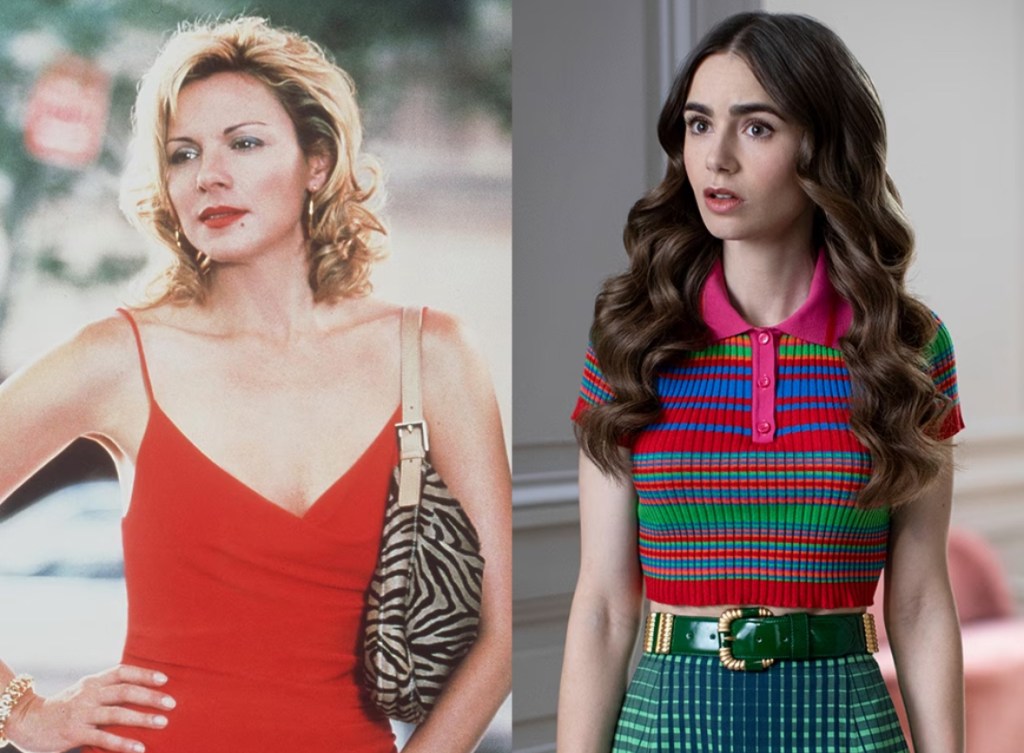
Twenty years may have passed since Sex and the City was released, but the dynamics of male-female relationships in the city haven’t changed much. Urban women continue to demonstrate sexual, personal, and occupational liberty, all while remaining just as invested in love. This is evident in the success of shows that, though often ridiculed for their triviality, become global hits because they resonate with audiences – especially female viewers – who see a part of themselves in this trope of a modern woman. A recent example of this is the Netflix show Emily in Paris, which, despite being criticized as a “tacky ripoff” of Sex and the City, offers an entertaining glimpse into what the modern woman’s been up to for the last twenty years. Emily, the main character, is a 21st-century counterpart to Carrie Bradshaw. After being transferred from Chicago to Paris for work and breaking up with her American boyfriend, she embarks on a new chapter of her life in a city renowned for romance, wine, art, and fashion. She explores her taste in fashion as well as her taste in men, going on dates, being flirtatious, and embracing a more sexually liberated lifestyle – that’s until she finds her very own, Parisian Mr. Big, who suddenly becomes the focal point of all her romantic endeavors. Although her life seems increasingly centered around wanting an emotionally unavailable man, she appears to challenge her Mr. Big – not for the sake of changing him, but rather to explore what she truly wants to commit to. Despite the relationship’s unrealistic elements, such as the arbitrary lack of communication and the string of unlucky coincidences that are nothing but annoying, the story of Emily and her Mr. Big – much like that portrayed in Sex and the City – offers some insights into the link between femininity in a contemporary sense and love. Prioritizing love doesn’t necessarily have to make women vulnerable, and male-dependent. Women have the autonomy to decide what kind of male-female relationship they want to pursue, and thus, love can serve as a form of embracing liberty. A modern woman can be a Carrie Bradshaw or an Emily Cooper – someone who, almost from day one, embarks on a quest for Mr. Right. She could also be a Miranda, seeking a male-female partnership, or Charlotte, looking for the prospective father of her children. Alternatively, she might be like Samantha, preferring finite romantic connections over a traditional notion of love. On top of being largely independent in various aspects of her life, the modern woman can always rely on her girlfriends, since no place fosters such a strong sense of sisterhood quite like a big city.
 Let's Rewind